

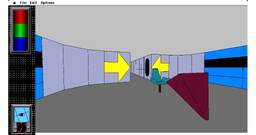
The ScummVM Team is pleased to announce that The Colony is ready for public testing! You are a Space Marshal responding to a distress call from the remote colony Delta 5-5. Something has gone terribly wrong. Before you can reach the planet, your ship is caught by a gravity well and crash-lands, leaving you stranded with a damaged vessel and a very simple problem: find out what happened to the colonists and find a way home.
Explore the colony in real-time 3D, moving through its corridors, laboratories, offices, homes, and other facilities as you search for clues. Read the colonists' notes, journals, books, and computer records to piece together what happened, while solving puzzles and dealing with the alien creatures that now roam the colony. You'll need to restore your ship's reactor, and if you can manage it, rescue the children who were placed in cryogenic chambers before the colony was overrun.
The Colony was an unusually ambitious game for 1988. Rather than presenting a collection of pre-rendered views, its engine allowed you to move freely through a continuously rendered 3D environment. You can explore on foot, enter vehicles, manipulate objects, and interact with a world that feels remarkably expansive considering that the original Macintosh version fits on a single floppy disk. The game combines exploration, logical puzzles, and combat, with much of the story hidden in the remnants left behind by the colonists.
Created by David Alan Smith and published by Mindscape, The Colony was one of the earliest games to combine a freely navigable first-person 3D environment with adventure-game exploration and puzzle solving. It went on to receive Macworld's Best Adventure Game of the Year award in 1988, and its technology would later form the basis for Smith's Virtus WalkThrough 3D environment.
For this testing period, ScummVM supports The Colony releases for Macintosh and DOS. As usual, you will need the original game data files to play, so either grab your old floppies or get a free copy of the game from ZOOM Platform. Please report any problems you encounter on our issue tracker, following our bug submission guidelines. Screenshots and saved games demonstrating an issue are always helpful.
Delta 5-5 closing transmission.